
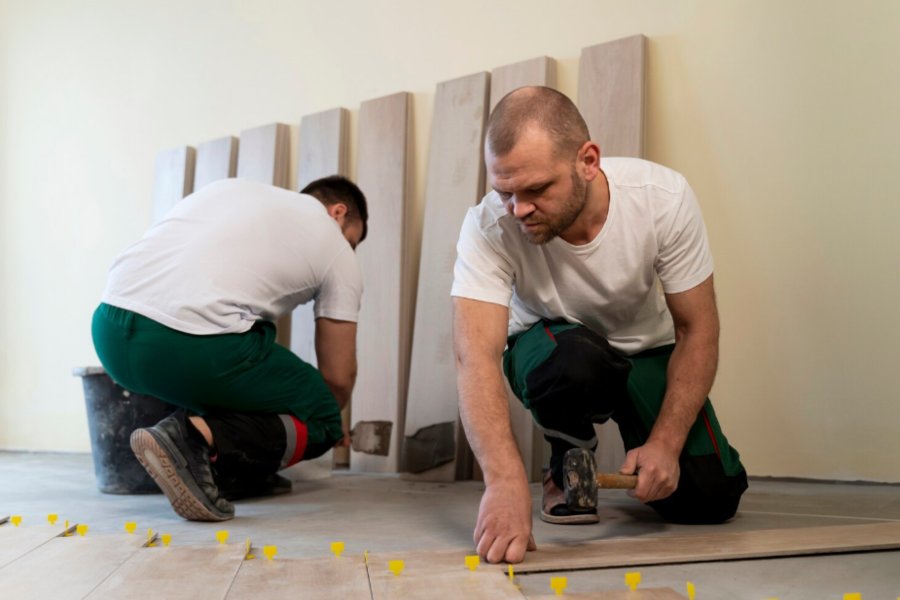
Flooring is one of the highest-impact decisions in any interior renovation — it affects the appearance of every room, the comfort of daily use, the maintenance demands on the homeowner or building manager, and the value of the property. In Chicago, where winters bring extreme cold and dry air, summers bring humidity, and many properties sit on older concrete slabs or subfloors with decades of settling and moisture history, the material choice and the quality of the installation are both critical to how a floor performs over its service life. Getting both right requires understanding what the options are, what Chicago’s climate demands, and what distinguishes a professional installation from one that will develop problems within a few years.
Flooring Options for Chicago Homes and Buildings
The Chicago market supports the full range of flooring materials — solid hardwood, engineered hardwood, luxury vinyl plank, ceramic and porcelain tile, laminate, carpet, and natural stone — each with distinct performance characteristics, cost profiles, and appropriate applications. No single material is right for every situation, and the best choice depends on the specific room, the subfloor condition, the expected traffic level, and the homeowner’s priorities around appearance, maintenance, and longevity.
Flooring chicago professionals assess each project individually — evaluating the subfloor condition, the moisture levels, the traffic patterns, and the client’s aesthetic priorities — to recommend the material that will perform best in the specific application rather than the one that is easiest to install or carries the highest margin.
How Chicago’s climate affects flooring material selection:
- Solid hardwood — responds to seasonal humidity swings by expanding and contracting; appropriate for above-grade installations with stable humidity control but vulnerable in basements and high-moisture areas
- Engineered hardwood — a veneer of real wood over a dimensionally stable core; handles Chicago’s humidity fluctuations better than solid hardwood and can be used in a wider range of subfloor situations
- Luxury vinyl plank — fully waterproof, dimensionally stable, and unaffected by humidity; the most practical choice for basements, bathrooms, and spaces with moisture exposure
- Ceramic and porcelain tile — impervious to moisture and very durable; appropriate for kitchens, bathrooms, and entryways but hard underfoot and cold in Chicago winters without radiant heat
- Laminate — more affordable than hardwood with reasonable durability, but sensitive to moisture and not appropriate for basements or areas with water exposure
- Carpet — provides warmth and sound absorption valued in Chicago winters but requires more maintenance and has shorter service life in high-traffic areas
Hardwood Floor Installation in Chicago: What the Process Involves
Hardwood floor installation is one of the more technically demanding flooring projects, and the quality of the installation determines whether a hardwood floor looks exceptional and lasts for decades or develops gaps, cupping, squeaking, and other problems within a few years. The most common installation failures in Chicago trace to two sources: inadequate subfloor preparation and failure to account for the seasonal moisture cycling that Chicago’s climate produces.
A professional flooring installer chicago addresses both issues systematically — measuring subfloor moisture and flatness before any material is ordered, allowing hardwood to acclimate to the installation environment for the appropriate period, and selecting the installation method that suits the specific subfloor type and the hardwood species and dimension being installed.
Key steps in a professional hardwood floor installation:
- Subfloor assessment — measuring moisture content, checking for flatness within 3/16 inch over ten feet, and identifying any areas requiring repair
- Hardwood acclimation — allowing the wood to equilibrate to the room’s temperature and humidity, typically three to seven days depending on species and current conditions
- Subfloor preparation — repairing high spots and low spots, securing loose panels, and applying moisture barrier where required
- Layout planning — establishing reference lines and planning the installation pattern to ensure balanced borders and visually correct alignment with the room’s geometry
- Installation — nail-down, glue-down, or floating method selected based on subfloor type and manufacturer requirements
- Finishing — sanding and finishing for unfinished hardwood; buffing and coating for prefinished products where required
- Transition and trim installation — thresholds, reducers, and base molding completed as part of the finished project
The acclimation step is one of the most frequently skipped in lower-quality installations and one of the most consequential. Hardwood installed without adequate acclimation will adjust to the room’s conditions after installation — either expanding and buckling if it was too dry when installed, or shrinking and developing gaps if it was too wet. In Chicago, where heated interior air in winter is very dry and summer air is humid, this adjustment can be dramatic if the wood was not properly conditioned before installation.
Subfloor Conditions in Chicago Properties
Chicago’s housing stock includes a significant proportion of older properties — two-flats, greystone buildings, bungalows, and courtyard buildings constructed in the early to mid-twentieth century — where the subfloor conditions present challenges that newer construction does not. Concrete slabs that have absorbed moisture over decades, wood subfloors that have settled unevenly, and underlayment layers from previous renovations that add height and create transition problems are common findings in Chicago renovation projects.
A flooring installer who encounters these conditions without addressing them first produces an installation that looks acceptable initially but develops problems as the floor settles and as seasonal moisture cycling exposes the underlying issues. A professional installer identifies these conditions during the initial assessment, communicates them clearly to the client, and addresses them before any new flooring is installed — even when doing so adds time and cost to the project.
Commercial Flooring in Chicago: Different Requirements, Different Standards
Commercial flooring projects in Chicago differ from residential installations in scale, traffic demands, timeline constraints, and the regulatory requirements that apply to commercial spaces. A restaurant, retail store, medical office, or office building experiences foot traffic and wear that residential flooring is not designed to withstand, and the consequences of a flooring failure — safety hazards, business disruption, and replacement cost — are significantly greater than in a home.
Commercial Flooring Chicago installations require materials specified for commercial use — with appropriate hardness ratings, slip resistance for required areas, and adhesive systems designed for the subfloor conditions and traffic levels of the specific space — installed by crews experienced in commercial project timelines and building access requirements.
Commercial flooring considerations that differ from residential projects:
- Traffic ratings — commercial-rated materials are specified by expected daily foot traffic volume, not aesthetic preference
- Slip resistance — ADA and OSHA requirements for coefficient of friction apply in commercial spaces and must be met in entryways, restrooms, and other designated areas
- Installation scheduling — commercial projects often require after-hours or phased installation to minimize business disruption
- Adhesive and seam requirements — commercial vinyl and carpet tile installations follow stricter seam and adhesive specifications than residential work
- Moisture mitigation — commercial concrete slabs in Chicago frequently require moisture testing and mitigation systems before flooring installation to prevent adhesive failure
- Warranty documentation — commercial installations require manufacturer warranty compliance documentation for building management and insurance purposes
Evaluating a Chicago Flooring Installer
Chicago’s flooring market includes a wide range of contractors, from established companies with dedicated installation crews and showrooms to individual operators who purchase materials at retail and subcontract the work. The difference in quality between these operators is significant and often not apparent from an estimate alone.
What to verify before selecting a Chicago flooring installer:
- Experience with the specific material — hardwood, LVP, tile, and commercial flooring each require different skills and equipment
- Subfloor assessment process — a professional will assess the subfloor before providing a final quote, not after work begins
- Acclimation protocol — how the installer handles material acclimation for wood and wood-based products
- Moisture testing — whether moisture testing is performed on concrete subfloors before installation
- Warranty terms — what is covered under the installation warranty separate from the manufacturer’s material warranty
- References from comparable projects — residential or commercial as applicable, in similar Chicago property types
The total cost of a flooring project includes not just the initial installation but the long-term performance of the floor — how it wears, whether problems develop, and whether the installer is accessible if warranty issues arise. An installation that costs less initially but develops cupping, gaps, or adhesion failures within a few years costs more in the end than one done correctly the first time.
Julhas Alam is a seasoned SEO strategist and the leading voice behind the insightful articles at LawFirmSEOExpert.com. With a rich background in digital marketing and a specialized focus on the legal sector, Julhas combines industry expertise with a deep understanding of SEO to deliver actionable insights and strategies tailored for law firms. Holding a passion for data-driven results and cutting-edge SEO techniques, Julhas has been instrumental in boosting online visibility and client acquisition for numerous law practices. When not dissecting search engine algorithms or exploring the latest digital marketing trends, Julhas enjoys reading success stories of other businesses, adding a personal touch to their professional acumen.